The Land Speed Record 1898-1919
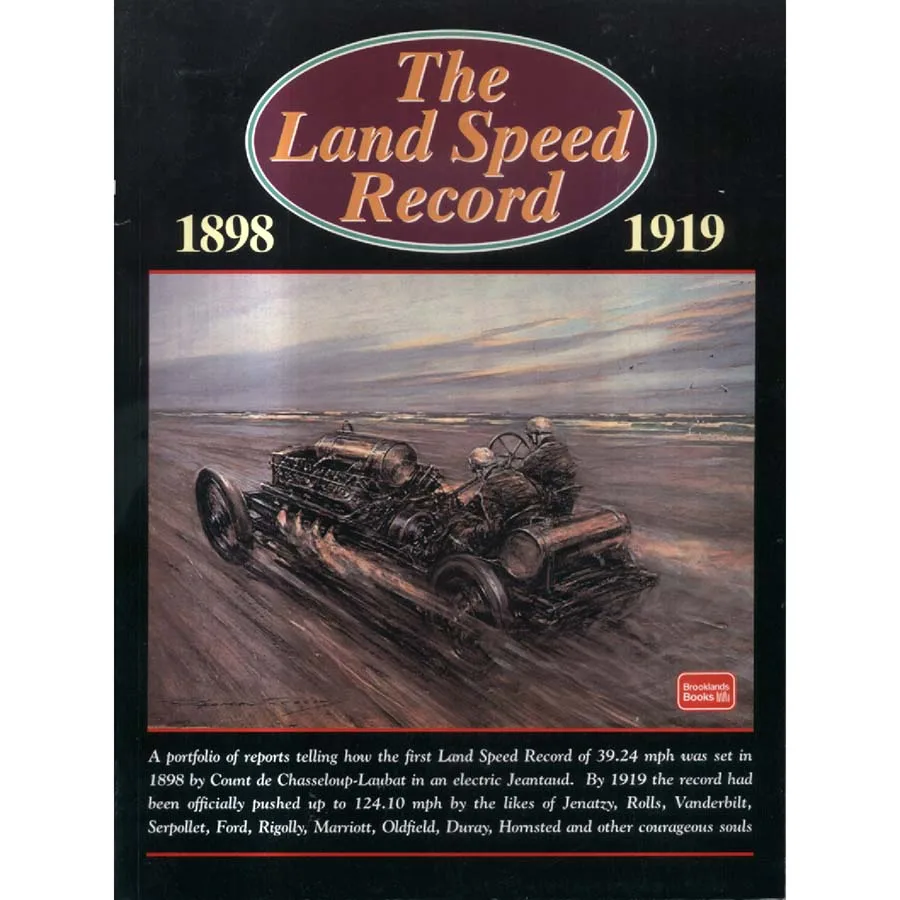
Publisher: Brooklands Books
Format: Paperback
ISBN: 9781855205130
There was a time when travelling at thirty miles per hour was considered an extraordinary achievement, sufficient to alarm pedestrians, terrify horses and convince respectable citizens that civilisation was approaching a mechanical catastrophe. Naturally, a small collection of magnificent lunatics immediately decided that thirty miles per hour was nowhere near fast enough and began constructing increasingly outrageous machines to discover precisely how quickly a human being could travel along the ground before something important fell off.
In The Land Speed Record 1898–1919 (1999), R. M. Clarke presents a fascinating collection of historical material documenting the pioneering years of the pursuit of absolute speed. Published by Brooklands Books, this specialist volume explores the remarkable vehicles, determined drivers and extraordinary engineering experiments that transformed the motor car from a noisy mechanical curiosity into a machine capable of astonishing performance.
The story begins in 1898, when Count Gaston de Chasseloup-Laubat established an officially recognised land speed record in an electric vehicle, proving that the electric car was apparently a rather good idea long before modern manufacturers began presenting it as an entirely revolutionary invention.
In these pioneering years, electric, steam and petrol-powered machines competed for supremacy, each offering its own peculiar combination of advantages, disadvantages and opportunities for mechanical disaster. Engineers experimented with increasingly powerful motors, elaborate bodywork and ingenious methods of persuading their creations to travel faster without immediately dismantling themselves.
Among the most celebrated achievements was Camille Jenatzy’s famous electric La Jamais Contente, which exceeded 100 kilometres per hour in 1899. Its streamlined shape resembled an enormous metallic cigar, demonstrating that aerodynamic thinking had arrived considerably earlier than the widespread availability of comfortable seating or sensible crash protection.
As the new century progressed, the quest for speed became increasingly ambitious. Engines grew larger, vehicles became more specialised and record attempts attracted extraordinary public interest. The competitors were an astonishing collection of engineers, aristocrats, adventurers and mechanically minded daredevils who regarded travelling at previously unimaginable speeds as a perfectly reasonable recreational activity.
Clarke’s historical compilation captures this extraordinary period of automotive experimentation, when every new record represented a triumph of ingenuity, determination and occasionally magnificent irresponsibility.
The years covered also witnessed the transformation of the automobile into a serious engineering achievement, although early record-breaking machines retained a distinctly alarming appearance. Many seemed to consist primarily of an enormous engine, four wheels and a courageous gentleman positioned somewhere behind the machinery.
Condition: Very Good. This is a previously owned copy dating from 1999, displaying only modest signs of age and handling. Unlike the pioneering record-breaking machines it describes, it requires no specialist mechanical attention, replacement tyres or a remarkably brave individual willing to operate it at dangerous speeds.
Published by Brooklands Books in 1999. ISBN: 9781855205130.
Offered by Crappy Old Books, where we admire the courage of early speed pioneers, particularly their willingness to risk life and limb proving that an enormous engine could travel considerably faster than was strictly necessary.
An excellent addition to any collection of historic motorsport, pioneering automotive engineering or land speed record literature. Particularly recommended for enthusiasts who appreciate that the pursuit of speed began long before modern supercars, when reaching sixty miles per hour was a sensational achievement and surviving the experience was considered an encouraging bonus.
Keep browsing: See more Transport books Other books by RM Clarke